Cultural Facets of Passing: How Loved Ones Are Kept Alive, Long After Death.

The month of February is bittersweet.  It is a month of rejoicing in love and friendship, but it is also the month I lost my paternal grandmother, a decade ago.  It was a difficult experience, but one that reverberated and branched out into a surplus of realizations thereafter.

Though my grandmother drew her last breath all those years ago, it has become a family tradition to visit her site of burial on the anniversary of her departure.  Homage is tenured through an endowment of flowers left at her headstone as well as participation in informal, yet synchronized remembrance and reflections in silence.

My siblings and I take turns exchanging memories, spinning hypotheticals:

“I miss the way she said my name.”

“Can you imagine her using one of today’s smartphones?”

“Would she be proud of me?” “Of us?”

Having served as the mainspring of our family, these subtle practices are effectuated to keep my grandmother’s essence alive.

The heavy, initial mourning stages of her corporeal exit have subsided with each passing year, however, I am not so certain that the grief felt is ever really more than intensely subdued.


It had rained the day I visited an inner city, Roman Catholic cemetery in New York City. It was brisk; the sky was still overcast – residual of earlier cloudbursts that moistened the earth, still spongy beneath my feet.  Headstones and mausoleums were freshly adorned with gently fallen droplets of rain.  In this condition, everything, time included, stood remarkably still in a city timestamped with the infamous New York Minute.  Although New York City is a domicile to sprightly melanges of folks, this locus of communal, eternal rest lay situated in a neighborhood of residents who are of predominantly Christian denomination.  I mention this because I’d never stopped to marvel at the artifacts meticulously left behind for loved ones until this visit.

What I observed took me aback.

screenshot_20170215-193602
Hope: A statute of an angel sits atop a headstone in an inner-city cemetery in New York City, New York, US.

On inspection, I was awe-struck to find the assemblage of palpable tchotchkes left to commemorate the departed were not all but mostly comprised of pious trinkets.  The abundance of symbolism chockablock in these mementos made it apparent that people actively made the pilgrimage to the memorial park at various times during the year, supplementary to their loved one’s anniversary of passing. Halloween visitations were marked by a friendly ghost decoration here, a jack-o-lantern there.  A plaque embellished with an etched cartouche banner acted as a backrest for a sun-bleached, plastic toy rabbit and assorted pastel eggs, nestled unwaveringly in well-manicured grass –  Remnants of an Easter passed. Ongoing occasions and accolades, such as graduations, were promulgated by tangible imagery of etiolated commencement caps and faux diplomas.

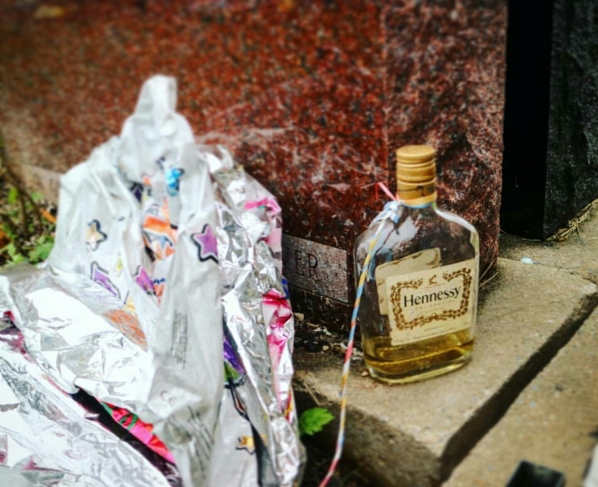
A near-empty, bottle of distilled spirits sat at the foot of a neighboring headstone; a gift ribbon adorned its glass neck and trailed to a deflated occasion balloon. In the absence of context, the symbolism of each token as it related to each respective perished could be only loosely deciphered and interpreted through the subjective lens with which I perceived it; even so, each object left behind unambiguously served as a micro testament to their persistent influence and impact on their beloved upon departure.

In this locale, the past, present, and future no longer seemed to bear immediate distinction and instead existed coevally. Crosses; angels; inscribed psalms; pinwheels; flags of various nations; photos; a toy car; dioramas; love notes and poems written by children, spouses, and friends; a miniature terrarium – all of these articles provided snippets of individuals – those who were once deeply embedded in society and, in their unique way, remain ongoing.
screenshot_20170215-193702
Happy Birthday: Artifacts left to acknowledge a special event.

Most societal groups on Earth take part in unique cultural enactments to memorialize the deceased.  In Korea, millions of people convene to honor their ancestors during a holiday known as Chuseok.  Chuseok takes place over the course of three days every year to commemorate those who have passed as well as the living.  People gather in ancestral hometowns to clean tombs, pray, and present palatable offerings.*

In Eastern Indonesia, when it comes to keeping the exanimate alive after death, the Toraja people of Tana Toraja, employ a stunning literal ritual approach – the demised are clothed, fed, and taken to special gatherings and ceremonies as though they were still very much animate.**
screenshot_20170215-193509
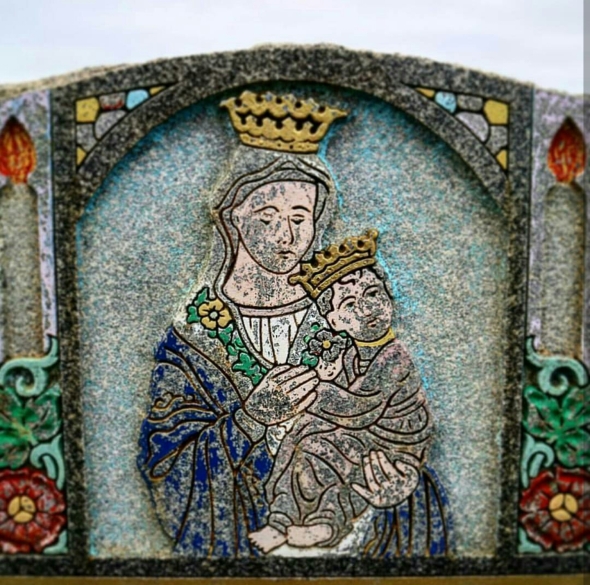
Headstone Art in an inner-city cemetery, New York City, New York, US.

In Western society, the discussion of death in any capacity – philosophical or legal – is oft met with discomfort and avoidance. However, there is beauty and art even in passing.  The idiosyncratic traditions spanning across world cultures, founded specifically to honor those who have perished are unequivocally indicative of the human experience; as a deponent to the silent tributes intended for personages who once teemed with vigor, I began to view death as less of a foreboding theme and more of a motif. By examining how people all over the globe cope with inevitable passing, we can begin to appreciate parallels in customs [and mechanisms for coping] that are strikingly similar to our own.

Traditions meant to immortalize those who have transcended universally bind all people; we are all fluent in the language of loss, suffering, and resurrection through the actions of the living.  Storytelling, customs, methodically placed reliquaries, passing down of names/surnames, mass communal events, and so on; these innately and entirely human behavioral applications keep us alive, long after we are gone.

Curiously enough, in return, my grandmother continues to furnish gifts of insight 10 years after our last physical embrace.

“The life of the dead is placed in the memory of the living.” – Marcus Tullius Cicero

Sources: http://english.visitkorea.or.kr/enu/ATR/SI_EN_3_6.jsp?cid=811650*

http://ideas.ted.com/11-fascinating-funeral-traditions-from-around-the-globe/**

DIY Hanging Kitchen Herb Garden!

I love Spring!  And I really, really love DIY crafts!

No, seriously – I live on Pinterest.  I’m also poor on a very rigid college student budget so, if I can make it, I will not buy it [within reason].  I thought it’d be great to combine my love of DIY with my love for Spring (as well as the need for thriftiness) and share a fun project I completed last year.

Even though it has been documented that plants can evoke positive psychological and physiological responses in people, green spaces remain a luxury in the city.  Not only are potted herbs pretty, but they can also serve as delicious add-ons for meals that you can grow in just about any tiny, New York City  kitchen!  I can feel my mood lifting already!

Let’s get to it!

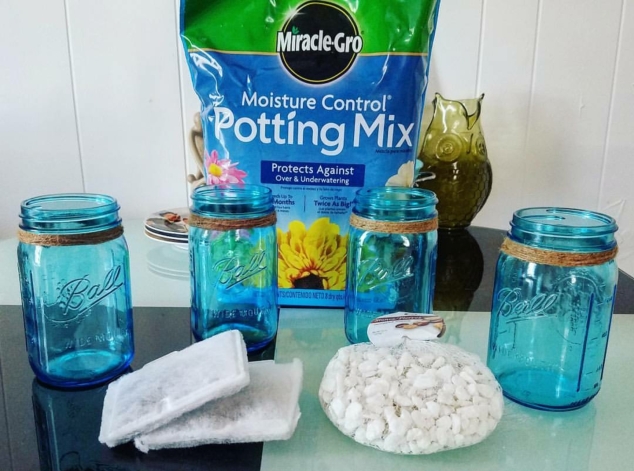
For this project I used:

  • 4 wall hooks and screws sets from home improvement store, ~$2 each
  • power drill and drill bit attachment to match hook screw heads
  • pencil (to mark wall hook placement)
  • measuring tape and/or leveler
  • twine/jute
  • hot glue gun + appropriate glue
  • 4 key rings
  • 4 wide-mouth 32 oz mason jars, blue
  • 1 bag of potting soil
  • bag of white rocks
  • potted herbs (can use seeds instead)
  • activated charcoal (optional)

I had most supplies on-hand and ready to go for this project.  After I gathered all materials, I got to work wrapping jute around the neck of each mason jar, tied a common knot, and dabbed a bead of glue to reinforce the knot.  I also affixed a key ring to the jute, knotted and dabbed a bead of glue to secure it in place as well.

Screenshot_20170425-114107

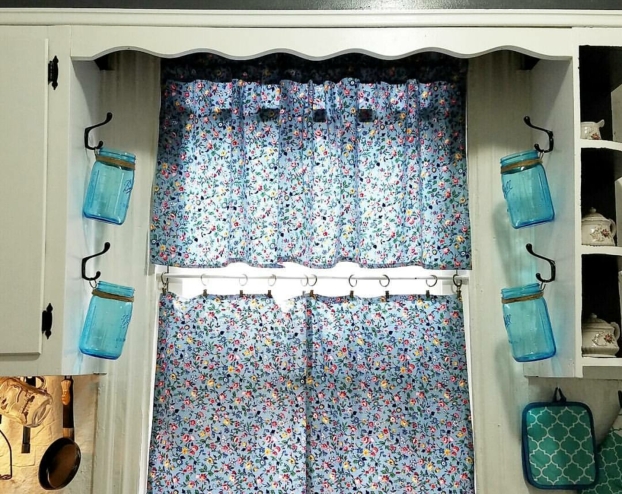
Next, I decided on hook placement and marked it off with a pencil.  A leveler and tape measure came in handy in ensuring that all four jars were appropriately spaced to allow for plant growth from jars underneath.  I dug out my trusty power drill and got to fixin’!  I drilled two screws into each hook and with that maneuver, they were able to hold the weight of the empty jars.  It was time to test key ring stability.

Screenshot_20170425-114149
DIY Fan: Curtains I made served as a pretty backdrop while I tested wall hook stability with empty mason jars.

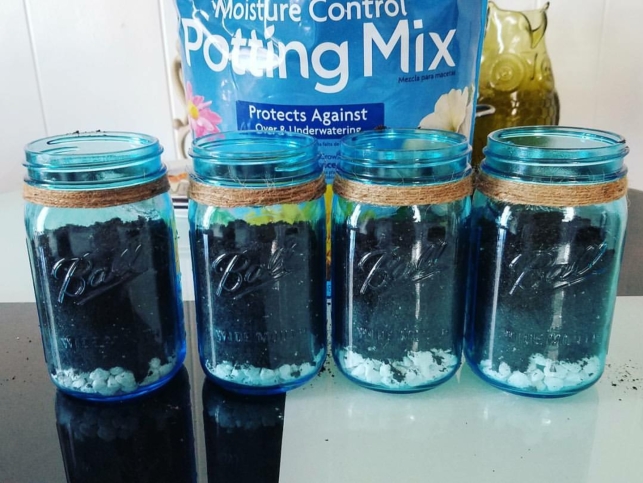
I filled one of the jars with white rocks to stand out against the blue glass.  Adding rocks to the base will promote drainage and keep plants from getting water-logged.  Next, I filled the jar with some activated charcoal.  Activated charcoal serves to keep mold and bacteria from building up in the pot, but it’s entirely optional.  I had activated charcoal left over from unused fish tank filters and decided to give it a second life in this project.  (Reduce, reuse, recycle!)  Lastly, I filled the jar with potting soil, leaving the jar about a third empty from the top.

I hung this jar on one wall hook with success.  The wall hook, key ring, and jute withstood the weight of the glass mason jar plus added materials.  I tested the rest of the wall hooks and was met with success.  I was ready to go!

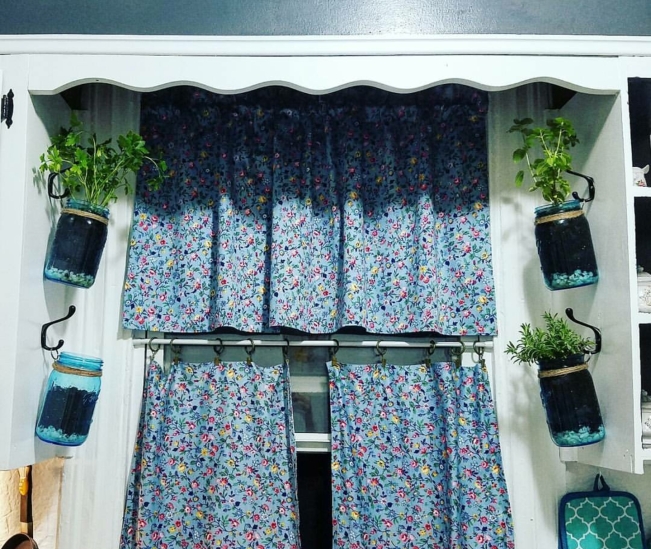
I filled the other three mason jars with rocks, activated charcoal, and potting soil.  Now, the fun (re: messy) part!  I transplanted store-bought, potted herbs to their new homes, being extra careful with their roots, and topped off the jars with extra potting soil.  I situated each jar on its individual hook, right above the kitchen sink.

Screenshot_20170425-114302

I was initially aware that my kitchen window does not receive much sunlight. I set out to implement a decorative system that would allow the potted plants to be portable and set back in their places after soaking up some sun near a well-lit window.  This, though not the most practical, actually worked out for some time.

Screenshot_20170425-114447
Pretty Hanging Kitchen Herb Garden.

One year later and the jars, jute, and key rings are still holding strong!  No falling mishaps!  Sadly, I transplanted herbs that were the last of the season, so they didn’t last as long as they would have had I purchased them much sooner.  This year, I’m looking forward to adding strategically placed grow lights, extending the layer of white rocks to increase drainage and transplanting Greek oregano along with parsley, basil, coriander/cilantro, or maybe mint, for those lemonade and mojito Summer nights!

The best part about growing your own herb garden at home? Cooking with fresh herbs on demand, of course!

Screenshot_20170425-232643
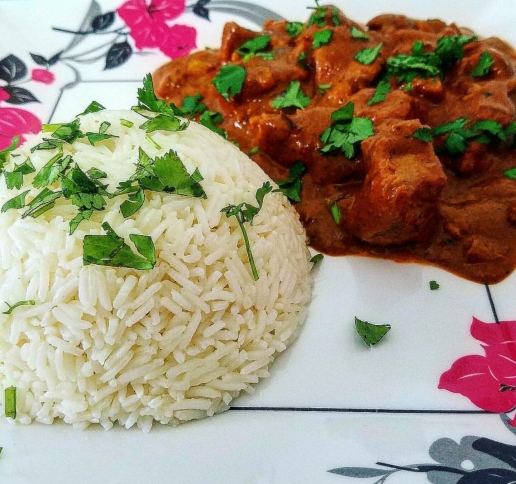
Chicken Tikka Masala and Basmati Rice garnished with fresh herbs.

Examining The Growing Need For Affordable & Accessible Hearing Aid Alternatives in Senior Populaces.

No Hearing Aid? Some Gizmos Offer Alternative to ‘Speak Up!’ written by Paula Span, was published in The New York Times on 15 July 2016.  Span addressed contemporary challenges individuals affected by varying degrees of hearing loss experience when considering the use of hearing aids.  As a result, those in need are turning to less conventional gadgets as a means to meet their auditory demands.

Particularly worrisome, according to Span, in the United States, the current prevalence of hearing loss is greater than forty-five percent among individuals aged 70-74.  The prevalence of hearing loss almost doubles for individuals over 85 years of age.  Even more alarming – less than twenty percent of people with hearing loss actually use hearing aids, yet, in our day and age of vast technological advancements, obtaining adequate hearing aid devices remains cumbersome for individuals in need.

So, what gives?

Span highlights the many obstacles which prevent individuals from obtaining adequate hearing aids: the stigma associated with hearing aid usage; high costs of hearing aids “$2,500 and up for a decent hearing aid…” (Span); and lack of health insurance coverage due to conditions under which Medicare was enacted in 1965, directly prohibiting this said insurer from providing monetary reimbursement and/or coverage for hearing aids.  Consequently, these hindrances have prompted individuals to investigate affordable and inherently less effective, alternative means.

Personal Sound Amplification Products (P.S.A.P.) have become easily accessible and widely available options for individuals living with hearing loss.  According to Span, P.S.A.P.’s can be obtained anywhere from online retailers to local drugstores averaging $40 in cost without a prescription nor proper fitting from a licensed Audiologist.  This is made possible because P.S.A.P.’s are not regulated by the Food and Drug Administration (FDA).  As a result, P.S.A.P. retailers are not permitted to directly market their devices as hearing aids.  Anyone who believes they possess any degree of hearing malady – diagnosed or otherwise – is at liberty to purchase and use P.S.A.P.’s as some devices are cleverly marketed to “amplify or test an individual’s hearing” (Span).

Given the lack of regulation and ease of access to P.S.A.P’s, individuals without a background in Audiology run the risk of potentially harming themselves with improper use or fitting of Personal Sound Amplification Products. The risk of losing funds as a result of investing in sub-par gadgets is also increased.  Of important consideration is, at their best, P.S.A.P.’s cannot provide aid to those with severe hearing loss.  While the allure of P.S.A.P.’s can be understood given the obstacles that limit the acquisition of appropriate hearing aids from medical professionals, as well as the necessity to improve quality of life, without appropriate professional mediation, individuals essentially put their health at further risk.

FDA-regulated hearing aids must be properly fitted by an Audiologist.  Unlike P.S.A.P.’s, hearing aids are specifically and uniquely tailored to meet each individual’s physical and auditory needs.  Still, for many individuals, the risks associated with purchasing and wearing P.S.A.P.s may pale in comparison to the risks and compromised quality of life associated with suffering from hearing loss.  Hearing loss can lead individuals to avoid social interaction with others; it can manifest as a sense of loneliness and low self-esteem, and contribute to overall poor health.  This inclination is especially applicable to senior populations.

Still, according to Span, some P.S.A.P.’s on the market claim comparable results to that of medically certified hearing aids.  However, it should be noted that only a few P.S.A.P. gadgets were put to the test on just 29 subjects.  A single trial conducted on such a limited demographic cannot be rendered appropriate or accurate enough to justify P.S.A.P.’s efficiency as compared with FDA-regulated, adeptly suited hearing instruments.  In desperation, individuals suffering from hearing loss may forego this analysis and accept small sample study claims as factual.  Despite this, several silver linings can be obtained from Span’s article.

First, Span describes the possibility of improving the merger of current, readily available technology with hearing aids to meet the needs of those with hearing loss.  Span offers that consumers should be able to pick out their preferred hearing aid online and be properly and safely fitted by an Audiologist.  Span also mentions the existence of the Jacoti Listen App, an FDA-regulated iPhone application that integrates the use of a popular mobile device with a directional microphone as well as earphones.

Brief Reflection:

As our aging populations inevitably acquire varying severities of hearing loss to improve their quality of life, it is imperative to consider the implications of limited access affordability.  At the very least, Span’s article served to underscore overdue awareness of the lack of practical wearable hearing solutions and further play up the call for reform of current Medicare practices that hinder access to much-needed, quality personal hearing apparatuses.

PCOS 101: Polycystic Ovarian Syndrome FAQ’s

I was diagnosed with Polycystic Ovarian Syndrome (PCOS) in 2007.

I was then a teenager, living in poverty and medically uninsured.  As a result, I received this diagnosis at a no-cost, first-come-first-serve inner-city clinic.

It went like this: before I could ask the assigned gynecologist to repeat the name of this foreign diagnosis, I thrust an 8×11 misaligned computer print-out consisting of loose, bulleted snippets of what I would later understand to be Polycystic Ovarian Syndrome (PCOS). She then crudely informed me I would not be able to bear children.* I was promptly dismissed from the facility to allow for insubstantial medical staff to accommodate the conveyor belt treatment of a dozen or so other uninsured women who were also in need of medical and diagnostic care.

Though I left with more questions than answers, though treated as cattle, I was relieved to learn that the cluster of symptoms I had experienced for some time had a name.  At last, I had an anchor.  I dedicate subsequent years to regaining my health, serving as my own advocate, and aiding in improving the lives of other women afflicted by PCOS.

I am not a doctor or medical professional trained to treat or diagnose metabolic, reproductive, or endocrine disorders or Polycystic Ovarian Syndrome (PCOS).  Below you will find a brief composite of commonly asked questions related to Polycystic Ovarian Syndrome (PCOS) which may be important to consider as part of a dialogue between you and your medical professional/team.

PCOS 101: Frequently Asked Questions

Q: What is Polycystic Ovarian Syndrome?

A: Polycystic Ovarian Syndrome, also known as PCOS or PCOD, is a health condition that affects women of reproductive age.  PCOS is one of the most common causes of infertility.

Q: What causes PCOS?

A: The underlying causes of PCOS remain unknown, however, it is likely that it is congenital and metabolic in nature.  Some experts believe that PCOS can be brought on by insulin resistance.  Others believe an androgen imbalance is also culpable.  Both schools of thought may be right as more and more medical research is beginning to suggest there are multiple types of PCOS.

Q: What are the symptoms of PCOS?

A: Symptoms of PCOS include:

Irregular menstrual periods

– Amenorrhea or no menstrual periods.

– Periods that occur too frequently (like more than once in a single cycle).

– Periods that are too heavy or last much longer than a typical period cycle (can last for months at a time if left untreated).

– Unpredictable periods, even when close monitoring with a calendar.

Infertility

PCOS is the leading cause of infertility in women who are of reproductive age.  Irregular periods can also lead to infertility.

Accumulation of Abdominal Fat/Obesity

While most women with PCOS are considered obese, it is important to note that slim women can also be affected by PCOS.  However, women with PCOS tend to gain weight in their midsections, leading to an “Apple” body shape.  Women with PCOS find it difficult to lose excess weight and keep it off with conventional methods of weight loss.  Further, there is a link between the accumulation of excess abdominal and insulin resistance.

Excess Androgens

An increase in male hormones (androgens) is often noted in women with PCOS.  The ovaries typically make small amounts of male hormones, however, in PCOS, more androgens are made which can lead to a hormonal imbalance.  Which can cause…

Hirsutism (or excess body hair)

Excess hair tends to show up in male patterns – on the face, chest, abdomen, and upper thighs.

Hair Loss

Female pattern hair loss has been reported in women with PCOS and can be attributed to higher than typical androgen levels present in women with PCOS.

Oily skin and severe acne that persists beyond adolescent years.

Oily skin and acne that persists into adulthood may be caused by excess androgens.  In this case, acne does not respond to conventional, over-the-counter acne treatments.

Acanthosis Nigricans

Thickened skin in darkened patches tends to occur on areas of the body such as the neck.

Cysts on Ovaries

Note: despite the name of this disorder, not all women diagnosed with PCOS suffer from ovarian cysts.  It is possible to be affected by PCOS without having ovarian cysts at all.

Depression/Anxiety

Women with PCOS may be more susceptible to depression and anxiety, possibly induced by hormonal changes as well as low self-esteem that may accompany the array of symptoms associated with PCOS.

Q: What is Insulin Resistance and what role does Insulin Resistance play in PCOS?

A: Insulin is a hormone released by the pancreas for the purpose of keeping blood sugar (glucose) in healthy ranges.  Insulin Resistance is a condition in which the cells in the body do not respond to the insulin that is produced, leading to difficulty in processing blood sugar and keeping blood sugar levels stable.  Prolonged elevated glucose levels in the blood can lead to Type 2 Diabetes.  As a result, women with PCOS are much more susceptible to diabetes.

Q: What causes PCOS?

A: The underlying causes of PCOS remain unknown, however, it is likely that it is a congenital condition.  Some experts believe that PCOS can be brought up by insulin resistance. Others believe an androgen imbalance is culpable.

Q: Can PCOS be cured or treated?

A: Currently there is no cure exists to eradicate PCOS, however, symptoms of PCOS can be treated and managed.  Treatment of PCOS can include one or a combination of the following:

– Birth Control or hormonal contraceptive methods to induce and regulate menstrual cycles, though efficacy for PCOS has been debated.

– Spironolactone treatment to manage hirsutism.  Note: Spironolactone is a blood pressure medication and it is not officially approved by the FDA to treat hirsutism in women with PCOS, though it can be prescribed for treatment if your doctor deems it appropriate.

– Metformin treatment to regulate insulin resistance.

– Healthy eating habits PLUS exercise.


* Sound familiar? Over the years, I have encountered women who have also endured this type of treatment –  especially if they were diagnosed in the early 00s. It is unprofessional, unethical, immoral, and medically irresponsible to conclude such a prognosis with regard to women’s reproductive capabilities without appropriate workups, considerations of medical history and familial history, as well adequate lab tests conducted and interpreted over time. It is even more abhorrent to render such a claim to a child without furnishing adequate diagnostic information for the patient to digest, proper facility and/or specialist referral, as well as counseling.

It is my hope that the information presented herein can serve as a springboard for adequate discussion surrounding women’s reproductive health at home and in medical institutions.

(Please feel free to print these FAQs to discuss with your primary doctor, GYN, and/or Endocrinologist).

Teaching Preschoolers: Life Lessons Learned.

When I initially began working as an educator in a preschool setting, I never imagined I would learn so many lessons on love, resilience, and gratitude.

No one is as honest and unabashed as a preschooler.  There’s this clumsy, energetic art in everything they do.

My preschoolers were 3-foot-tall beings who survived almost exclusively on raw emotion and fruit snacks.  They existed in their truest forms; they were the most open and genuine human beings I have ever encountered.

My preschoolers were fascinated by the minute things in life.  They were excited to gift me freshly picked flowers (and weeds).  They were excited to draw pictures and leave their art in my classroom “mailbox.”  They were excited about creatures and things big and small – real and imagined.  It was through them I learned to cherish the “simplest” of moments.  It was through them I learned to slow down and take in my surroundings and appreciate the littlest things, wherever I might be.

Screenshot_20170215-184300
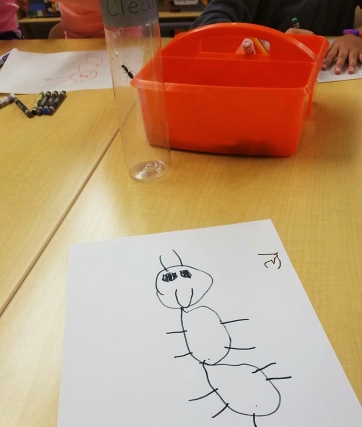
Class Pet: Students found an ant friend living in the classroom crayon bin. How silly! We later released our ant buddy into its natural habitat.

My preschoolers taught me the true importance of politeness and courtesy.  As adults with adult responsibilities, it is easy to succumb to living and operating on auto-pilot.  During a typical morning rush, I’d pay a habitually forced, “Good morning” to a local deli clerk while digging in my bag for loose change, scurrying out to meet the time-sensitive demands of public transit well before he had the true chance to respond.  My preschoolers were living examples of how a smile and enthusiastic hug in the morning goes a long way in transforming a seemingly crummy, rudimentary day into an intentional one.  While I don’t have any plans to release oxytocin by hugging my local store clerk, I’ve made it my business to properly and politely greet him.  In doing so, I learned that he is a Yemeni immigrant who keeps pictures of his two beautiful daughters in his wallet. There is a big, beautiful world outside of our commutes and outside of our own heads.

screenshot_2016-01-21-23-20-04
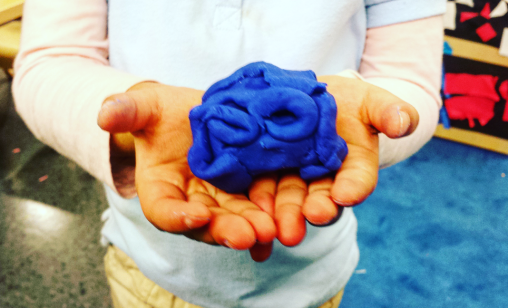
“I made you!” Clay sculpture made in my likeness, glasses and all!

My preschoolers served as comedians, showing me the importance of maintaining a sense of humor and making time to be silly.  One of my students once looked terrified after spilling milk “on accident.”  Without skipping a beat, his observant peer noted that the spilled blotch of milk “looks like a pig!” Worry was met with positive reassurance, laughter, ample opportunities for connection with others, and socio-emotional growth.  We were often brought together and were able to overcome tense situations as a class through shared moments of laughter.

My preschoolers served as humanitarians.  As touched on above, students often held space for one another with and without educator lead intervention. I would often observe students consoling their classmates in times of need completely on their own.  Scraped knees on the playground were met with pats on the back and, “Don’t worry. You’ll be okay.  Your mommy will be here soon.”  In this particular scenario, students demonstrated the significance of considering others’ emotional states and consoling those in need when appropriate, and through their actions, they indirectly modeled this behavior to the rest of their peers.

screenshot_20170215-184337
Preschoolers prepare toy dolls for their “baths” during Dramatic Play.

My preschoolers served as little philosophers; their inquisitive nature prompted them to question everything.  I appreciated and admired their echoes of “Why?” As adults, we are more inclined to accept what we hear and what we are presented, especially within the realms of health and politics. They reminded me to question and think critically with regard to what I am shown.

My preschoolers served as motivators for pursuing my dreams.  Their brazen demeanors taught me to stand by my aspirations even if, at times, that would mean standing alone.  They played a pivotal role in my decision to quit pivot my career as an educator to pursue studies in my calling: Speech-Language Pathology.

Screenshot_20170218-195921
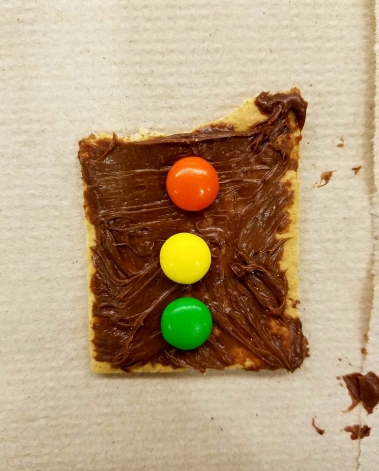
Yummy graham cracker traffic light.

Still, most notably, my preschoolers took up space.  They lived as their truest selves and served as proof we all possess innate qualities to be whomever/whatever we want to be. There is only one of you and the world is made beautiful because you are in it – show up as *You*.

These children will most likely forget me as they age, but they were the true educators.  I may have taught them letters, numbers, how to use scissors, and how to open their milk cartons, but their influences on the lens with which I experience life and interconnect with others will always resonate with me.

Screenshot_20170215-184212